


May We Gather 2024
A National Buddhist Pilgrimage for Asian American Ancestors
• Save the Date • Saturday, March 16, 2024 in Antioch, California
• Save the Date • Saturday, March 16, 2024 in Antioch, California

Our invitation
We invite you to join us in Antioch, California on Saturday, March 16, 2024 for the May We Gather (MWG) 2024 pilgrimage. There is no cost to register or attend. Due to space restraints, in-person attendance will be limited to 350 people. The ceremony will be livestreamed for those who wish to participate virtually.
The ceremony and pilgrimage have passed. Registration is now closed. You can view a recording of the indoor ceremony by tapping the button below.
Date
Saturday, March 16, 2024
12pm-5pm Pacific Time
LOCATION
El Campanil TheatRE
602 W 2nd Street
Antioch, California
Our pilgrimage consists
of three parts:
PART 1
MWG Ceremony in Antioch’s El Campanil TheatRE
1-2:30pm PT
PART 2
Peace Walk in the surrounding area, approximately half a mile long
PART 3
Community reception
at the Antioch Senior Center
415 W 2nd St, Antioch, CA
TRANSPORTATION
We strongly recommend that you arrive between 12–12:30pm to ensure ample time for parking, on-site registration, and getting comfortably seated for the ceremony. The ceremony will begin promptly at 1pm Pacific Time in Antioch, California.
-
Address:
602 W 2nd St, Antioch, CA 94509
Free parking will be available in the numerous public lots near the El Campanil Theatre, including the Palms Lot near G Street, the Nick Rodriguez Community Center parking lot between 2nd and 3rd and F Street, and the Beede (unpaved) parking lot on the corner of 2nd and E Street. Please check parking signs for time limits.
By BART + Bus: Take the Yellow Line/Antioch Train and get off at the final terminal, Antioch Station. Take the Tri-Delta Westbound Bus 387 and get off West 2nd and Waldie Plaza bus stop. Use the Bay Area Rapid transit (BART) Trip Planner for recommended public transportation routes and times: www.bart.gov/planner
By AMTRAK: Take the San Joaquin train line and get off at the Antioch-Pittsburg station. The El Campanil Theatre is located three blocks east, on 2nd Street.
By Car:From San Francisco
Take I-80 E
Continue on I-80 E
Merge onto CA-24 E
Merge onto I-680 N
Merge onto CA-4 E to Contra Loma Blvd in Antioch Take exit 27 for Contra Loma Blvd toward L Street
Take L St to W 2nd St
Turn left onto Contra Loma Blvd
Continue onto L Street
Turn right onto W 2nd street
The El Campanil Theatre will be on the left
From Los Angeles
Take I-5 N, follow signs for San Francisco/Sacramento
Merge onto I-580 W
Take exit 63 for Grant Line Rd
Turn left towards Mountain House Road
Turn left onto County Hwy J4/Byron Hwy/Byron-Bethany Rd
Turn left onto Camino Diablo
Turn right onto Vasco Rd
Continue onto CA-4
Take exit 28 for A St toward Lone Tree Way
Continue on A St. Drive to W 2nd St
Turn right onto A St
Continue onto W 2nd St
The El Campanil Theatre will be on the right
-
We are committed to making the May We Gather ceremony and pilgrimage as safe and accessible for our participants as possible. We recognize that in-person gatherings are still unsafe for many; however, we hope that following COVID-19 mitigation practices will allow people to participate more fully in this special program, which brings together families, elders, and communities across multiple states. Wearing an N95 face mask will be optional but strongly encouraged, and we ask that if you feel sick (even with a mild cold or flu), please stay home and join us via the livestream online. We will continue to monitor community levels and hospital admission rates in the San Francisco Bay Area, and may announce additional precautions as needed.
NEARBY AIRPORTS
Oakland - OAK
(46 miles to the southwest)
San Francisco - SFO
(58 miles to the southwest)
San Jose - SJC
(68 miles to the south)
Sacramento - SMF
(68 miles to the north)
ACCOMMODATIONS
We will provide recommendations for hotels to those who register for the pilgrimage.
NEWSLETTER
To receive the latest information about the pilgrimage and future programming, please sign up for our newsletter by entering your name and email below.

Why Antioch?
Antioch, California is located at the confluence of the Sacramento and San Joaquin Rivers. Home to Bay Miwok Tribes such as the Julpun for thousands of years, Antioch was incorporated in 1872 and, in addition to its Indigenous community, includes people of African, Asian, and European decent among its 19th-century inhabitants. In the 1940s, Mexican, Filipino, and Midwestern families joined the Antioch workforce of Antioch’s paper mill and glass factory.
This diverse city came to our attention when it became the first city in the United States to sign a formal apology acknowledging its history of discrimination against its Asian American community.
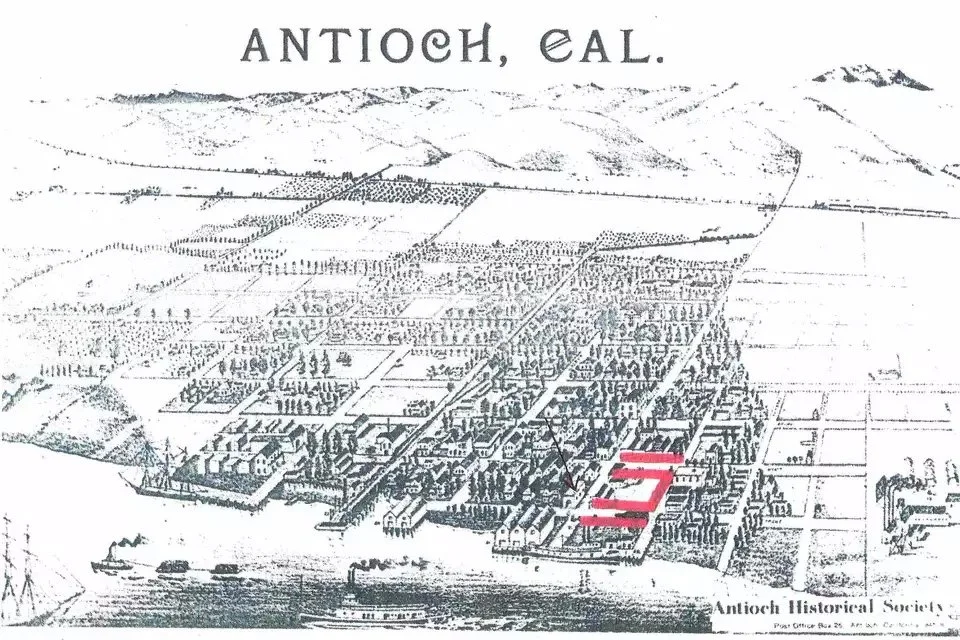
In the 1800s, Antioch's Chinatown consisted of homes and stores on both sides of First and Second streets, from G to I Streets, as highlighted in red on the map.
Antioch Historical Society & Museum
Later we learned that the burning of Antioch’s Chinatown in 1876 was precipitated by the scapegoating of six Chinese women for spreading immorality and illness, and recognized a parallel with the targeting of six Asian massage workers in the Atlanta-area shootings.
Both cases were shaped by racial (white) and religious (Christian) notions of morality that were used to justify violent attacks. In the case of Antioch, the racial and religious sentiment prevented the long-term establishment of the Chinese community and their religious practices. A temple that once stood on Wyatt Street now only exists in the historical record.
We gather in Antioch to recover this history, to acknowledge the legacy of America’s racial karma as demonstrated by the Atlanta-area shootings and the ongoing racial violence in Antioch, and to heal as a sangha.